Fastpitch Softball · Guide
Softball catcher's gear vs baseball: what you can reuse and what you cannot
A family with a son who caught and a daughter who has just volunteered asks the same question every spring: can she wear his gear? The answer is piece by piece, and it turns on one measurable thing — the ball is bigger. Here is which items cross over, which one genuinely does not, and what it costs to fix.
By Mike M.Updated Researched · every figure sourced
#adReader-supported: we may earn a commission if you buy through our links, at no extra cost to you. It never decides a pick. How we pick · Disclosure
What crosses over, piece by piece
| Piece | Reuse from baseball? | Why |
|---|---|---|
| Helmet / mask | No | Cage geometry is built around ball diameter; a softball mask has a widened eye gap |
| Chest protector | Yes, if it fits and is NOCSAE-marked | Torso length is sized to the kid, not the sport |
| Leg guards | Yes, if the length is right | Knee-to-ankle measurement is the only variable |
| Catcher's mitt | Sometimes | A size question: softball catchers generally want 33 in and up |
| Pelvic protector / cup | No, but it is the cheap piece | Different shape; a female pelvic protector is its own item |
| Throat guard | Yes | Hangs from the mask and fits most of them |
Read that table and the practical answer falls out: if you already own a youth baseball set that fits her, you are buying a helmet and possibly a mitt, not a set. That is a materially different bill from the one most parents expect when they are told softball gear is different.
The ball is the whole reason
Everything else follows from that number. A cage designed so a 9-inch ball cannot pass through the bars does not need the same spacing as one designed for a 12-inch ball, and a cage designed for the bigger ball can open the eye gap up, which is a genuine visibility improvement for the catcher. That is why makers build them separately rather than relabelling one.
It is also why the swap does not work in the other direction. A softball mask on a baseball catcher has gaps wide enough for a baseball to reach the face, which is a safety failure rather than a comfort one. The crossover is one-way at best and in practice neither way.
The mask: the one you cannot reuse
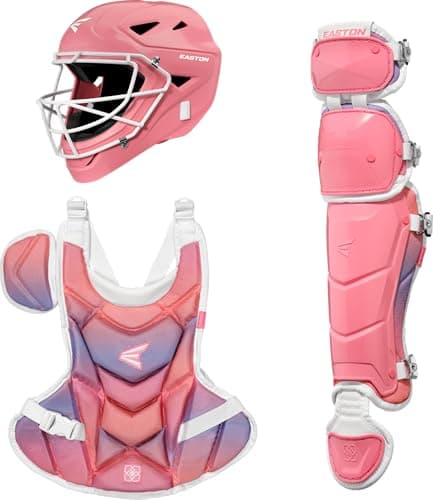
Easton's youth softball catcher's set is explicit about this: the helmet has a softball-specific widened eye gap and an extended eye bar, and the maker states the helmet is made only for balls 11 inches and larger. That is about as direct as a maker gets, and it is the sentence to point at when a coach tells you her brother's mask will do.
Practically, this is also the piece where the softball-specific market is thinnest. Full youth softball catcher's sets exist but the range is narrow, and Easton's young-player set is listed in XS only. Above that size most fastpitch catchers are in gear from the general catcher's-gear shelf with a softball mask, which is an entirely normal arrangement.
If your daughter is at the younger end, the purpose-built softball set is worth the money precisely because of the helmet. If she is older, buy the set that fits her torso and legs and put a softball mask on it. The age-band breakdown is on best youth softball catcher's gear.
Chest protector and leg guards
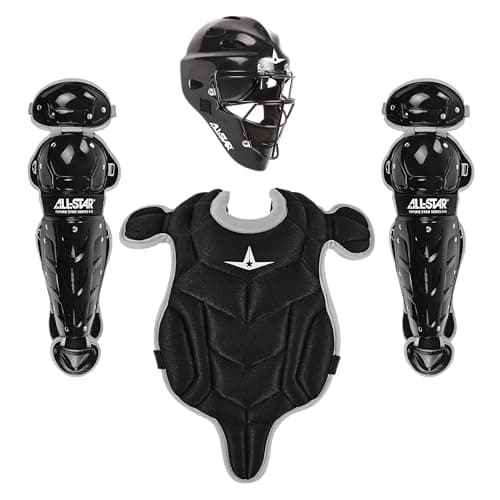
These two are sized to the kid and nothing else, which is why they cross over cleanly. A chest protector is measured as a torso length — Rawlings publishes its Players 3 chest protectors at 15 inches for Youth (12 and under), 14 inches for Junior (9 and under) and 10 inches for T-Ball (6 and under), and All-Star names its Future Star protectors by age band and length, 13.5 inches for ages 7 to 9 and 14.5 for 9 to 12.
Those numbers are the only thing that matters. If the protector that fit your son at ten fits your daughter at ten, it works, provided it carries the NOCSAE marking her league requires. Measure from the top of the sternum to the navel and match the published length — the full method is on youth catcher's gear size chart.
Leg guards are the same: measure knee to ankle and buy the published length. The only wrinkle is that fastpitch catchers block a riser rather than a bouncing curveball, and some find a hinged guard easier to move in. That is a preference, not a requirement.
The mitt: a size question, not a sport question
A catcher's mitt has no fingers and a reinforced pocket, and it is measured round the circumference rather than heel to fingertip like a fielding glove. Softball catchers generally use bigger patterns than baseball catchers of the same age, for the obvious reason that the ball is bigger.
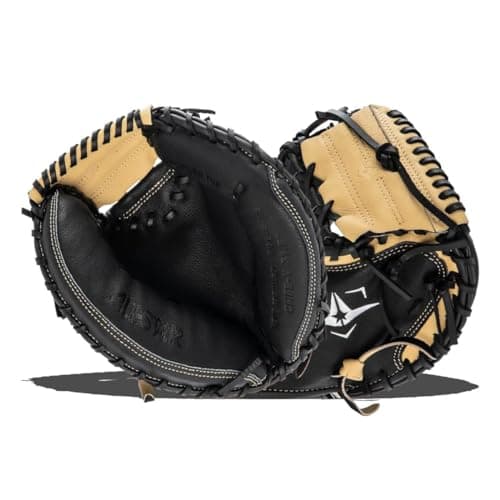
In youth sizes that means a 7- to 9-year-old softball catcher is usually fine in the same 31.5 inch pattern a baseball catcher of that age uses, and a 10- to 12-year-old wants 33 inches or more where her baseball counterpart might be at 32.5. All-Star sells the Future Star mitt in 31.5 and 33.5 inch patterns, which brackets the whole youth range for both sports.
So the honest answer on the mitt is: try the one you own. If the ball keeps popping out of the pocket, she needs a bigger pattern. If it holds, you have saved a hundred dollars. The ranked youth mitts are on best youth catcher's mitts.
What to buy, depending on what you own
Our picks for this
Sets and pieces for a crossover season
Certification wording, sizes and included pieces are quoted from the maker. Check the chest protector length against her torso before you check anything else.
Best youth softball catcher's set
Easton Jen Schro My Very First Youth Softball Set
The purpose-built youth softball set for ages 6 to 11: a helmet with a softball-specific widened eye gap made for balls 11 in and larger, a chest protector cut to eliminate gaps, and hinged leg guards. XS only.
$229.99Amazon#ad · Price as of November 3, 2026 · Disclosure for the link to Easton Jen Schro My Very First Youth Softball Set
Best starter set from a catcher's-gear specialist
All-Star Future Star Series Catcher's Kit
Sold by age band including T-Ball, 7-9 and 9-12, with the chest protector named by length. The set to buy when you are sizing to the kid rather than the sport, and pairing it with a softball mask.
$139.95Amazon#ad · Price as of November 3, 2026 · Disclosure for the link to All-Star Future Star Series Catcher's Kit
Best youth catcher's set overall
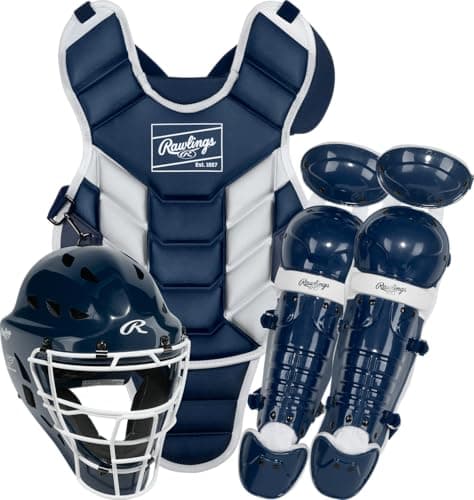
Rawlings Players 3 Series Catcher's Set
T-Ball, Junior and Youth sizes with a published chest-protector length table, and Rawlings states the chest protector meets the NOCSAE standard on the Youth and Junior models. The reusable-across-siblings set.
$175.88Amazon#ad · Price as of November 3, 2026 · Disclosure for the link to Rawlings Players 3 Series Catcher's Set
Best youth catcher's mitt overall
All-Star Future Star Catcher's Mitt (31.5 / 33.5 in)
Ages 7–12 (31.5 in for 7–9, 33.5 in for 10–12)8.9/10Sold in 31.5 in and 33.5 in patterns, which brackets youth baseball and youth softball catchers alike. Buy the 33.5 for a 10- to 12-year-old fastpitch catcher.
$99.95Amazon#ad · Price as of November 3, 2026 · Disclosure for the link to All-Star Future Star Catcher's Mitt (31.5 / 33.5 in)
What the certification covers either way
The certification question does not change between the sports, and it is the thing leagues actually check. The piece under scrutiny is the chest protector: NOCSAE's ND200 standard exists to address commotio cordis, the cardiac event caused by a blow to the chest at exactly the wrong moment in a heartbeat, and a growing number of organisations now require a chest protector that meets it.
Makers state their compliance in their own words and the wording varies — “meets NOCSAE standard”, “SEI certified to the NOCSAE standard”, “Youth and Junior models only”. Read the exact line on the piece you are reusing, because a hand-me-down set bought four years ago may predate the requirement entirely. The rule in full is on the NOCSAE chest protector rule explained.
That is the one place where “it fits, so it will do” is the wrong answer. Fit decides comfort; the marking decides whether she is allowed to crouch behind the plate at all.
How we picked these
Researched, certification-checked and sized for the age
Every pick on this page earns its place the same way: the certification is checked against the governing bodies' rules and the maker's stated stamp, so the gear is legal for the division it is bought for; sizing comes from the makers' own age, height and hand charts; the published specs (drop, barrel, construction, closure, cleat type) are read from the maker's page; and the patterns in verified buyer reviews sharpen the “best for” line on each card. Every figure links to where it came from, with the date.
Scores are editorial judgments built from that documented research, applied with the same weights to every product in a category, so the ranking is comparable top to bottom. Commissions never set a score or decide a pick. The rubric and its weights are published.
Questions parents ask
Frequently asked
Is softball catcher's gear different from baseball?
Can a softball catcher use a baseball catcher's mask?
Can a baseball catcher use a softball mask?
Can my daughter use her brother's chest protector?
What size catcher's mitt for a youth softball catcher?
How big is a softball compared with a baseball?
Keep reading
Related on Bat & Bucket
Receipts
Sources
- Easton: Jen Schro My Very First youth softball catcher's set (ages 6-11)
- All-Star: Future Star Series catcher's kit
- Rawlings: Players 3 Series catcher's set (Youth/Junior/T-Ball; chest protector size table)
- All-Star: Future Star catcher's mitt (31.5 in and 33.5 in)
- Balls.com: Little League Softball ball specifications (Rule 1.09 quoted: 11 in Tee Ball/Minor, 12 in Majors and up)
- Little League Softball: Divisions (league ages, pitching distances)
- NOCSAE: statement on the ND200 performance standard
- NOCSAE: Commotio cordis and the ND200 chest protector standard
Certification rules come from the governing bodies' own pages (Little League, USA Baseball, USSSA, NOCSAE), sizes from the makers' published sizing charts, and specs from the maker's product page or the retailer listing named on each product. Every figure above links to the page it was read from, with the date. Amazon prices move often, so each buy button takes you to the current price. Read the full method.