Helmets & Catcher's Gear · Guide
The NOCSAE chest protector rule, explained for parents
Somewhere in your league's email there is a line about NOCSAE-certified chest protectors, and the listings you are shopping use at least three different phrases for it. This page sorts out what ND200 actually is, what each phrase on a product page does and does not promise, and how to check the set in front of you.
By Mike M.Updated Researched · every figure sourced
#adReader-supported: we may earn a commission if you buy through our links, at no extra cost to you. It never decides a pick. How we pick · Disclosure
League rules as of Oct 10, 2026. Every rule on this page was read from the governing body's own page on that date, and each is linked. Leagues and tournaments change bat and gear rules between seasons (USSSA's 14U bat rule changed on January 1, 2026): confirm on the linked page and with your league before you buy, and tell us if a rule has changed.
What ND200 is
NOCSAE is the National Operating Committee on Standards for Athletic Equipment. It writes performance standards; it does not make or sell equipment and it does not certify products itself. SEI, a separate certification body, tests and certifies products against NOCSAE standards. So the chain is: NOCSAE writes ND200, a manufacturer builds to it, SEI certifies that it meets it, and the product page says so.
ND200 is the standard for chest protectors specifically. It is not the same as the NOCSAE standards for batting helmets or catcher's masks, which are separate documents covering separate pieces of equipment. A set can carry a NOCSAE-certified helmet and a chest protector that is not certified to ND200, and several youth sets do exactly that.
What commotio cordis is
That is the whole reason this standard exists, and it is why the chest protector is the one piece of a catcher's kit not to economise on. A blow to the chest from a foul tip or a bad bounce is not an unusual event for a catcher; it is a normal part of the position.
Who requires it
- High school (NFHS) and college (NCAA): NOCSAE states that their rules specify equipment certified to ND200.
- Youth leagues: this varies, and it is changing. A growing number of leagues and state associations require an ND200 chest protector for catchers, and some require it in writing. Yours may or may not; one email answers it.
- Tee ball and coach pitch: usually no requirement, and often no certified chest protector in the box either. See the T-ball exception below, because it is the most common gap between what a parent assumes and what the set actually contains.
Because the requirement moves between seasons and between associations, the rule note at the top of this page matters: the NOCSAE pages cited here were read on 10 October 2026, and your league's current rulebook is the authority on what it requires this year.
The three phrases on product pages
Listings use at least three different formulations and they do not all mean the same thing. Here is what each one actually says, with the makers' own wording on sets this site ranks.
| Phrase on the listing | What it claims | Example as published |
|---|---|---|
| “Meets NOCSAE standard” | Built to a NOCSAE chest standard. Does not name the commotio cordis standard specifically. | Rawlings Players 3: “Chest Protector Meets NOCSAE Standard (Youth & Junior ONLY)” |
| “Meets NOCSAE commotio cordis standard” | Names the standard ND200 was written for. The claim you want if your league requires ND200. | Rawlings Velo 2.0: the chest protector “meets NOCSAE commotio cordis standard” via the Arc Reactor Core |
| “SEI certified to the NOCSAE standard” | Names the certifying body as well as the standard. The most explicit of the three. | All-Star S7 AXIS: helmet and chest protector stated as SEI certified to the NOCSAE standard |
A fourth pattern is worth knowing: All-Star puts “Meets NOCSAE” in the product title of its Top Star, Future Star and S7 AXIS sets, which makes it easy to spot on a shelf. Easton states that the Black Magic 3.0 helmet meets NOCSAE for all levels of play, which is a helmet claim and not a chest-protector claim. Read which piece the sentence is about.
The T-ball exception parents miss
So if your 7-year-old is moving from tee ball into coach pitch and already owns a T-ball set, check the certification line on the box before the season rather than after. The size step is usually the Junior model: the sizing tables are on the youth catcher's gear size chart.
How to check a set before you buy
- Find the certification line, not the marketing copy. On Rawlings and All-Star pages it is a labelled specification field, often reading “Certified As”.
- Check which piece it refers to. Helmet, mask and chest protector are separately certified. A set with a certified helmet tells you nothing about its chest protector.
- Check the size band. Certification claims are sometimes limited to particular sizes in a family, as the Players 3 shows.
- Look for the sewn-in label on arrival. Certified chest protectors carry the standard on a label. Keep the box and the paperwork if your league asks for proof.
- Ask the league the exact question. “Does our division require an ND200-certified chest protector this season?” Not “is NOCSAE gear required”, which gets a vague answer.
Three sets, three levels of claim
These three show the progression in the makers' own words, from a general NOCSAE chest standard to a named commotio cordis claim to an explicit SEI certification. Every certification line on every card is quoted from the maker's page and linked there.
Our picks for this
From 'meets NOCSAE' to 'SEI certified'
Read the claim, not the price. All three are legitimate sets; they differ in how specific the maker is willing to be about which standard the chest protector meets.
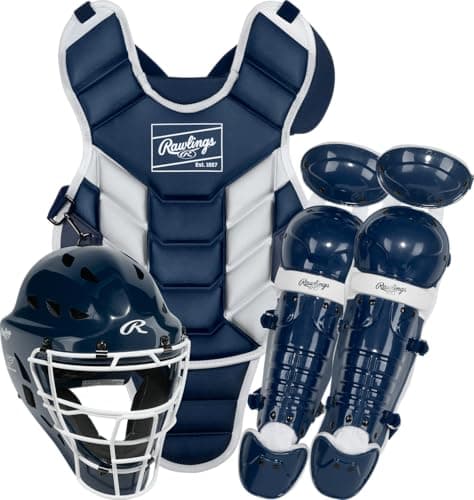
Best youth catcher's set overall
Rawlings Players 3 Series Catcher's Set
The first set, in T-Ball, Junior and Youth sizes. The chest protector is stated to meet the NOCSAE standard on the Youth and Junior models only, so read the size line.
$175.88Amazon#ad · Price as of November 3, 2026 · Disclosure for the link to Rawlings Players 3 Series Catcher's Set
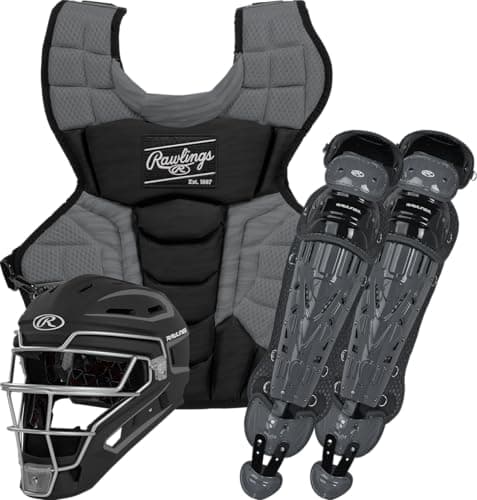
Best catcher's set for 12–15
Rawlings Velo 2.0 Catcher's Set
Names the commotio cordis standard directly, via the Arc Reactor Core chest pad, in Youth, Intermediate and Adult sizes. The set for a committed 11- to 14-year-old catcher.
$331.16Amazon#ad · Price as of November 3, 2026 · Disclosure for the link to Rawlings Velo 2.0 Catcher's Set
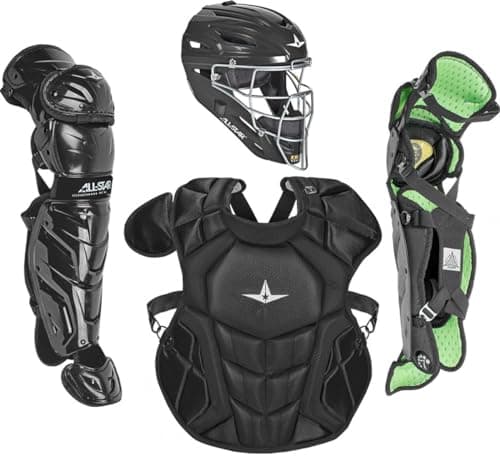
Best intermediate catcher's set for 12–16
All-Star S7 AXIS USA (Ages 12–16)
The most explicit claim here: All-Star states the helmet and chest protector are both SEI certified to the NOCSAE standard. Ages 12-16, 15.5 in chest protector.
$479.95Amazon#ad · Price as of November 3, 2026 · Disclosure for the link to All-Star S7 AXIS USA (Ages 12–16)
A certified protector that fits badly is not protecting
The standard tests the equipment, not the way your kid is wearing it. A chest protector that is too long rides up into the chin in a crouch; one that is too short leaves the bottom of the sternum exposed, which is the area the standard exists to cover. Both of those are fitting problems and neither is solved by a certification label.
So measure: from the base of the throat to the top of the belt line, and match that to the maker's chest protector length, not to the kid's age. Rawlings publishes a chest protector table for both the Players 3 and the Velo 2.0, and All-Star names the length in the product title. The measuring method is on the youth catcher's gear size chart, and the full ranked list of sets is on best youth catcher's gear sets.
How we picked these
Researched, certification-checked and sized for the age
Every pick on this page earns its place the same way: the certification is checked against the governing bodies' rules and the maker's stated stamp, so the gear is legal for the division it is bought for; sizing comes from the makers' own age, height and hand charts; the published specs (drop, barrel, construction, closure, cleat type) are read from the maker's page; and the patterns in verified buyer reviews sharpen the “best for” line on each card. Every figure links to where it came from, with the date.
Scores are editorial judgments built from that documented research, applied with the same weights to every product in a category, so the ranking is comparable top to bottom. Commissions never set a score or decide a pick. The rubric and its weights are published.
Questions parents ask
Frequently asked
What is the NOCSAE ND200 standard?
What is commotio cordis?
Does youth catcher's gear have to be NOCSAE certified?
What is the difference between 'meets NOCSAE standard' and 'SEI certified'?
Do leg guards need to be NOCSAE certified?
Is a T-ball chest protector NOCSAE certified?
Keep reading
Related on Bat & Bucket
- Best youth catcher's gear setsEvery set, with its certification quoted.
- Youth catcher's gear size chartMeasuring for the chest protector.
- Best catcher's gear under $200What the budget sets do and do not claim.
- Rawlings Velo vs All-Star S7Two of the picks on this page, head to head.
- Best youth softball catcher's gearThe same rule on the fastpitch side.
Receipts
Sources
- NOCSAE: Commotio cordis and the ND200 chest protector standard
- NOCSAE: statement on the ND200 performance standard
- Rawlings: Players 3 Series catcher's set (Youth/Junior/T-Ball; chest protector size table)
- Rawlings: Velo 2.0 catcher's set
- All-Star: S7 AXIS USA ages 12-16 catcher's kit
- All-Star: Top Star Series ages 9-12 catcher's kit
- All-Star: Future Star Series catcher's kit
- Easton: Black Magic 3.0 youth catcher's set (ages 6-12)
Certification rules come from the governing bodies' own pages (Little League, USA Baseball, USSSA, NOCSAE), sizes from the makers' published sizing charts, and specs from the maker's product page or the retailer listing named on each product. Every figure above links to the page it was read from, with the date. Amazon prices move often, so each buy button takes you to the current price. Read the full method.