Practice & Gear Bag · Guide
Pitching machine speed by age: the number, and why the distance matters more
A machine set to 50 mph at 30 feet is not a 50 mph pitch. Reaction time is the thing that matters and it is a function of speed and distance together, which is why makers publish speeds as simulated at a stated distance. Here is how to set a machine for a 7-year-old, how to move it up, and the sign you have gone too fast.
By Mike M.Updated Researched · every figure sourced
#adReader-supported: we may earn a commission if you buy through our links, at no extra cost to you. It never decides a pick. How we pick · Disclosure
Speed by age, as a starting point
There is no governing-body table for this and no maker publishes one, so treat the numbers below as a starting point calibrated to what kids actually face in games rather than as a rule. The honest version is: start at the bottom of the machine's range and move up when he earns it.
| Age | Starting setting | Typical game pitching distance |
|---|---|---|
| 5–7 (tee ball, coach pitch) | Lowest setting, or a tee instead | Coach pitch, roughly 35–40 ft |
| 7–8 (machine pitch, first kid pitch) | About 40 mph | 40–46 ft |
| 9–10 | About 45–50 mph | 46 ft |
| 11–12 | About 50–55 mph | 46–50 ft |
| 13–14 | About 55–65 mph | 54–60 ft 6 in |
Two caveats that matter more than the numbers. First, a machine repeats the same pitch to the same spot, which is far easier to hit than a kid of equivalent velocity, so a hitter will handle a higher machine setting than he handles in a game. Second, the setting means nothing without the distance, which is the next section.
What “simulated at 25 feet” means
That is not marketing sleight of hand; it is the only honest way to state it. What a hitter responds to is reaction time: how long the ball is in the air between release and the plate. A ball travelling at 45 mph from 25 feet gives him roughly the same time to react as a much faster ball from 46 feet, which is why a machine throwing a genuinely slow ball from close range can simulate a fast one.
So the dial and the tape measure are two halves of one setting. Decide what reaction time you want, then pick a distance and a speed that produce it — and once you have it, write both down, because a session set up from memory next weekend will not match.
Move the machine, not the dial
For a young hitter, the better way to increase difficulty is to move the machine closer at the same speed rather than to turn the speed up at the same distance. The ball arrives sooner, which is the challenge you wanted, but it arrives on the same flat, predictable path he has already learned to read.
Turning the speed up at a fixed distance changes the ball flight as well as the timing: a faster setting from a wheeled machine carries flatter and can start arriving above the strike zone, which produces a kid swinging at pitches he should be taking. With a 7- or 8-year-old, that is how a practice session turns into bad habits.
The exception is once a hitter is twelve or thirteen and facing real velocity in games. At that point simulating game speed from close range stops being useful, because he needs to track the ball over its real flight path, and the machine should go back to something close to the real pitching distance.
The signs you have gone too fast
- He is late on everything. Fouling balls straight back or to the opposite field on every swing means the ball is beating him. Slow it down or move it back.
- He stops striding. A hitter who feels rushed cuts out his load and his stride to save time. That is the clearest tell and the one most likely to persist into games.
- He bails out. Stepping away from the plate is a fear response and it is contagious across a season. Stop the session and reset the machine.
- He stops wanting to do it. The point of a backyard machine is volume. A setting that makes practice unpleasant costs you more reps than it buys.
The opposite tell is just as useful: if he is hitting hard line drives on nine of ten pitches, the setting is now too easy and he is grooving rather than improving. Move it up a notch or a foot.
The ball matters as much as the speed
Youth machines are built around lightweight balls, and that choice shapes everything. JUGS' Lite-Flite machine throws Lite-Flite balls; its Small-Ball machine throws 5-inch foam balls; PowerNet's Launch F-Lite ships with six F-Lite baseballs and six 12-inch F-Lite softballs in the box.
That is why these machines are safe in a garage and why they cost a fraction of a real-ball machine. It is also why you cannot simply feed them regular baseballs: the machine is calibrated for the ball it ships with, and a hard ball at those wheel speeds is a different and much more dangerous object.
A smaller ball has a second benefit that is easy to miss. A kid who learns to hit a 5-inch foam ball consistently finds a regulation baseball enormous by comparison, which is the same logic coaches use when they put hitters on smaller balls indoors. The full ranked field is on best pitching machines for kids.
Three machines and their published ranges
Our picks for this
Youth machines, with the maker's stated speeds
Every speed below is quoted from the maker and tied to the distance the maker states it at. Check the bottom of the range as carefully as the top — for a 7-year-old, the lowest setting is the one that matters.
Best value pitching machine
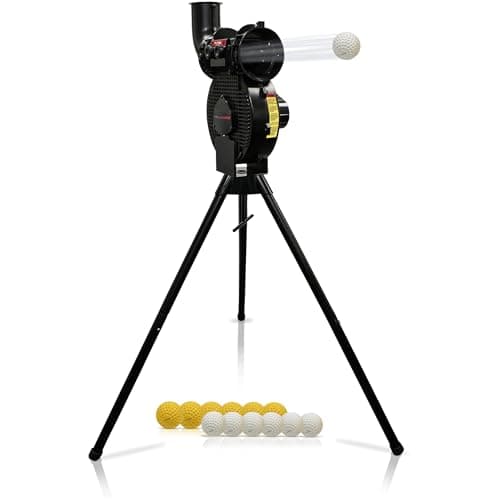
PowerNet Launch F-Lite Pitching Machine
Ages 7 and up (40 mph setting)8.2/10Four settings simulating 40 to 90 mph at 25 feet, with a breaking-ball bracket and twelve balls in the box. The 40 mph low setting is the reason this suits a 7- or 8-year-old.
$409.99Amazon#ad · Price as of November 3, 2026 · Disclosure for the link to PowerNet Launch F-Lite Pitching Machine
Best pitching machine for kids overall
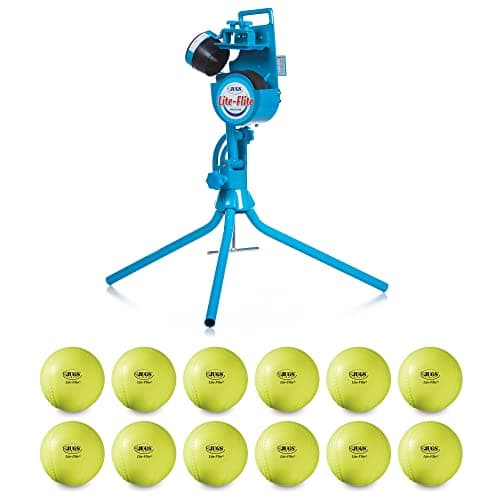
JUGS Lite-Flite Machine
Ages 8 and up (Lite-Flite balls)8.1/10Simulates speeds up to 85 mph at 25 feet and throws fastballs, curves and sliders from both sides for baseball and softball. The machine for a kid ready to see spin.
$679.99Amazon#ad · Price as of November 3, 2026 · Disclosure for the link to JUGS Lite-Flite Machine
Best garage pitching machine
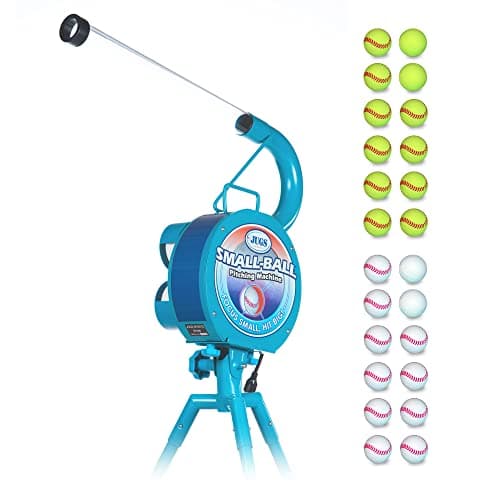
JUGS Small-Ball Pitching Machine
Ages 8 and up8.0/10Throws 5 in foam Small-Balls at 55 to 75 mph from 25 feet. About 23 lb and safe in a garage, with a small ball that sharpens a hitter's eye.
$469.00Amazon#ad · Price as of November 3, 2026 · Disclosure for the link to JUGS Small-Ball Pitching Machine
Backyard safety rules
Four rules, none of them optional. Nobody stands beside or in front of the machine while it is running — feeding is done from behind the wheel. The hitter wears a helmet, every time, including in the garage. The machine is unplugged or switched off before anyone walks out to pick up balls. And an adult runs it: a nine-year-old feeding a machine for a younger sibling is how the accidents in this category happen.
One more that is specific to youth machines: do not feed a ball the machine was not built for. The wheel speed is calibrated to a light ball, and a regulation baseball through the same wheels leaves faster and hits harder than anything the setting suggests.
If you are putting a machine into a backyard you also need a net behind the hitter and something to catch the balls, or you will spend the session walking. The setup is on backyard baseball practice setup and the nets are on best baseball hitting nets.
How we picked these
Researched, certification-checked and sized for the age
Every pick on this page earns its place the same way: the certification is checked against the governing bodies' rules and the maker's stated stamp, so the gear is legal for the division it is bought for; sizing comes from the makers' own age, height and hand charts; the published specs (drop, barrel, construction, closure, cleat type) are read from the maker's page; and the patterns in verified buyer reviews sharpen the “best for” line on each card. Every figure links to where it came from, with the date.
Scores are editorial judgments built from that documented research, applied with the same weights to every product in a category, so the ranking is comparable top to bottom. Commissions never set a score or decide a pick. The rubric and its weights are published.
Questions parents ask
Frequently asked
What speed should a pitching machine be for a 7-year-old?
What speed should a pitching machine be for a 10-year-old?
What does 'simulates 85 mph at 25 feet' mean?
Is it better to move the machine closer or turn the speed up?
Can you use real baseballs in a youth pitching machine?
How do I know the machine is set too fast?
Keep reading
Related on Bat & Bucket
Receipts
Sources
- JUGS: Lite-Flite pitching machine
- JUGS: Small-Ball pitching machine
- PowerNet: Launch F-Lite pitching machine with breaking ball bracket
- Little League: Bat Information (rules by division)
Certification rules come from the governing bodies' own pages (Little League, USA Baseball, USSSA, NOCSAE), sizes from the makers' published sizing charts, and specs from the maker's product page or the retailer listing named on each product. Every figure above links to the page it was read from, with the date. Amazon prices move often, so each buy button takes you to the current price. Read the full method.